



The AI fluency trap: why 59 per cent of organisations get it wrong
TestGorilla’s latest research reveals how companies are hiring for a term they cannot define – and offers a roadmap for verification

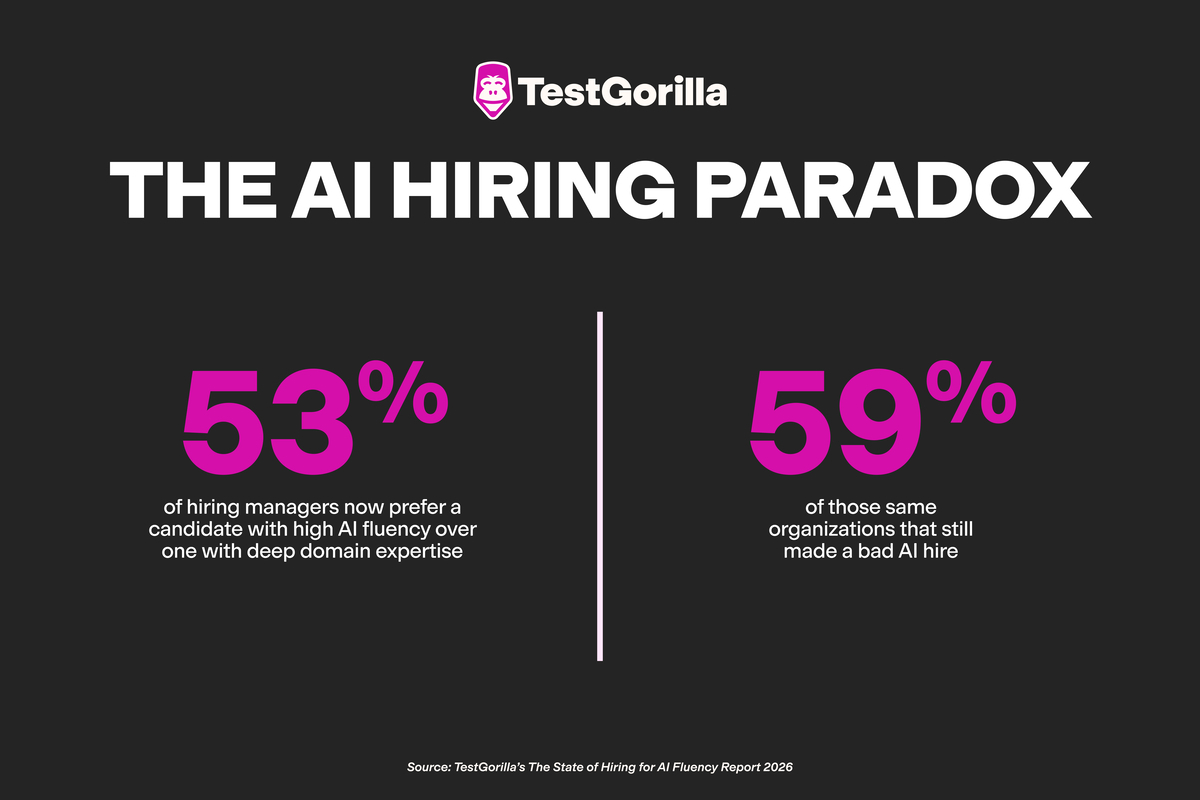
The world of recruitment has reached a definitive turning point. Fluency in AI is no longer a nice-to-have niche skill; instead, it’s become the primary lens through which talent is evaluated. According to new research from skills-based hiring platform TestGorilla, which surveyed nearly 2,000 senior hiring leaders across the US and UK, a staggering 53 per cent of managers now prefer a candidate with high AI fluency over one with deep domain expertise.
“This represents one of the most significant priority shifts in modern recruitment history,” says Wouter Durville, CEO of TestGorilla. “Organisations are no longer just looking for subject matter experts; they are looking for ‘AI-augmented’ performers who can use emerging technology to increase their output tenfold.”
Yet despite this urgency, the data reveals a troubling paradox. While organisations are desperate for AI talent, they are remarkably poor at identifying it. More than half of the organisations surveyed, roughly 59 per cent, report having made a bad AI hire in the past year, despite having some sort of internal framework in place for defining AI fluency.
The confidence vs competence gap
Why is the failure rate so high? The problem lies in what TestGorilla calls the “confidence vs competence gap”. Companies often see candidates who said the right things when it comes to AI in the interview room (confidence), but then failed to put those skills into practice once they were on the job (competence).
TestGorilla believes this is down to superficial “signals” that the hiring industry has relied on for decades: the right degree; the right previous employer; or a confident answer to a technical question. “AI fluency is currently being filtered through this same broken funnel,” says Durville. “In the current market, a candidate can learn the vocabulary of AI terms, such as ‘agentic workflows,’ ‘RAG,’ and ‘prompt chaining’ in a single weekend. They can describe a workflow convincingly without ever having built one.”
TestGorilla’s research shows that the interview, as currently structured, is designed to observe communication, not execution. In other words, it finds the best storyteller, not the best hire. Perhaps more eye-opening is that 19 per cent of people surveyed said their organisation leaves the assessment of the candidate’s AI skills entirely to the discretion of the hiring manager. Meaning a huge swathe of companies aren’t actually measuring a candidate’s capability, but rather just rewarding their ability to play the part of an expert.
A global divergence: the US vs the UK
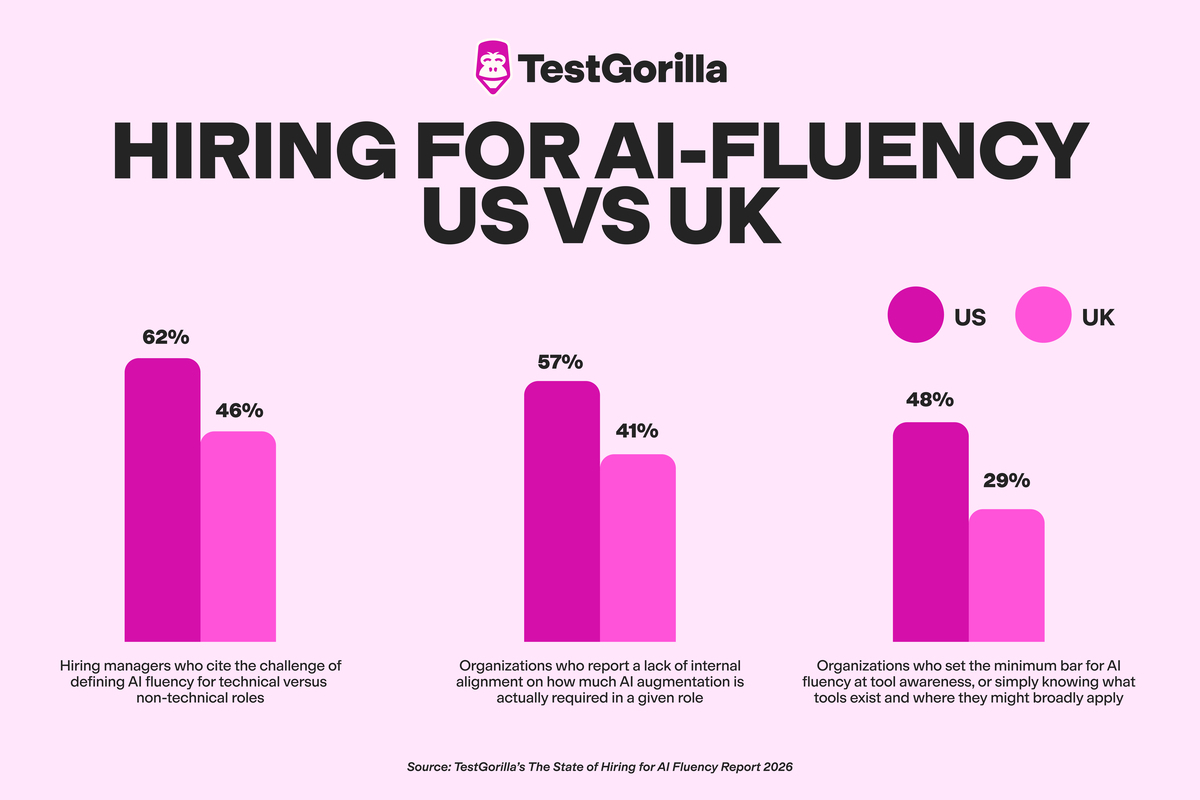
One of the most striking findings in the report is the structural divergence between the US and UK markets. US organisations report a significantly higher rate of AI-driven errors (33 per cent) compared with their UK counterparts (13 per cent).
The reason is found upstream in the hiring process. In the US, 45 per cent of organisations set their minimum bar for AI fluency at mere “tool awareness” – in other words, the simple knowledge that a tool exists and what it might do. In contrast, UK organisations are more disciplined, with a higher concentration requiring independent use and verification. This, Durville argues, is critical to a company fixing its hiring process: “A major improvement is not to ask more probing questions about self-reported usage. It’s to stop treating self-reports as evidence at all and start requiring demonstration that they can build an AI workflow during the hiring process.”
The solution: moving from conversation to verification
This is just one of the fixes that TestGorilla advocates for. At the conclusion of the report, TestGorilla shares its proprietary and internal “Five-Pillar Framework” to give organisations a practical roadmap to move beyond definitions and into measuring data points that actually signal performance.
The five pillars that the company claims are the most important are:
- Applied AI use: the ability to deconstruct work and execute tasks using generative AI
- Digital agility: the “meta-skill” of staying current as tools inevitably change
- Systems thinking: understanding how AI use ripples across the entire organisation
- Responsible ethics: the judgment to catch a hallucination before it becomes a liability
- Collaboration: the ability to communicate AI logic transparently to a team.
“The era of subjective AI hiring must end,” says Durville. “For organisations to truly thrive in the AI era, they must stop hiring for ‘readiness’ and start hiring for proven, verifiable fluency. The candidates who can deliver are out there. The question is whether your process is designed to find them.”
To find out more and download the full research report, please visit www.testgorilla.com/state-of-ai-fluent-hiring.
By Wouter Durville, CEO, TestGorilla

Business Reporter Team
You may also like





Most Viewed


Winston House, 3rd Floor, Units 306-309, 2-4 Dollis Park, London, N3 1HF
23-29 Hendon Lane, London, N3 1RT

020 8349 4363

© 2025, Lyonsdown Limited. Business Reporter® is a registered trademark of Lyonsdown Ltd. VAT registration number: 830519543