



UK shoppers and AI: the trust gap retailers must close
British consumers are the world’s most reluctant AI shoppers – for retailers racing to deploy agents, understanding why matters.

Nearly half (48 per cent) of UK consumers say they will not use AI when shopping for clothes, the highest rejection rate of any market surveyed globally. That’s ahead of Germany (38 per cent), the US (37 per cent), and a world away from China (10 per cent) and South Korea (8 per cent). For an industry chasing every possible efficiency gain from artificial intelligence, that’s a number worth sitting with.
But to understand the reluctance and what retailers can actually do about it, you first need to understand the context in which British consumers are shopping right now.
Squeezed wallets meet sky-high expectations
UK consumer confidence collapsed in March 2026. The British Retail Consortium’s economy outlook index dropped from -30 in February to -53 in March – its lowest reading since the survey launched. The GfK Consumer Confidence Index simultaneously fell to -17, its lowest level in nearly a year, with the largest decline in households’ assessment of the economic outlook over the next 12 months. Meanwhile, the Confederation of British Industry reported the sharpest annual fall in retail sales since April 2020.
Energy costs are a major driver of that declining confidence. The Bank of England now forecasts CPI to rise to between 3.0 per cent and 3.5 per cent in the second and third quarters of 2026 due to higher energy prices. KPMG UK puts the potential peak at 3.6 per cent in September, keeping inflation above the bank’s 2 per cent target for the coming year. For households facing another Ofgem price cap increase in Q3, with energy bills still running £600 above their pre-crisis average, discretionary spending is under real pressure.
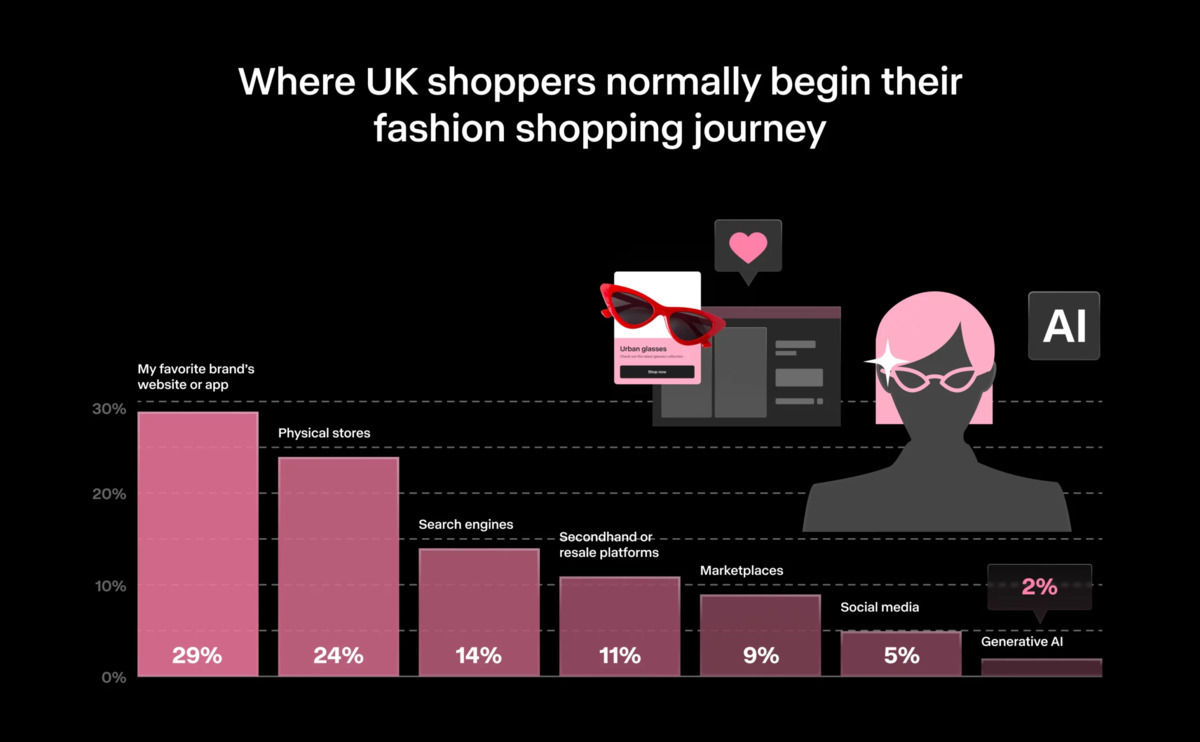
In this environment, British shoppers have become intensely value-driven. Over the past quarter, Primark, Vinted and Next recorded the strongest growth in brand search share. UK shoppers lead globally in starting their journey on second-hand platforms such as Vinted – 11 per cent do so, more than any other market surveyed. Next’s rise is different: not a budget brand, but one that cut prices two years ago and is now winning because of it.
When value trumps everything else
That value-first mindset also shapes where UK shoppers prefer to start their shopping journey most: 29 per cent begin directly on brand websites or apps; 24 per cent still prefer to shop in-store. British shoppers are selective: when every purchase carries more weight, they gravitate towards channels they already trust. So it’s no surprise that in this market, trust and transparency are table stakes.
Trust, not technology, is the real AI barrier
The UK’s AI scepticism wasn’t born from ignorance. British shoppers understand what the technology can do. What they object to is what it might do without their knowledge or consent. And their concerns are specific:
- Personal style: the worry that AI won’t understand individual taste speaks to something deeper than aesthetics and reflects a distrust of algorithmic personalisation when shoppers feel their individuality matters more than ever
- Spending control: the fear of losing control over purchases is acutely rational in a cost-of-living context where every pound counts
- Biased recommendations: scepticism about sponsored results is well-founded, given the chequered history of recommendation engines in prioritising margin over relevance
Even among shoppers open to AI, the expectation is clear: they want support, not replacement. AI earns its place in price comparison, where 23 per cent see its value, and in product discovery, noted by 17 per cent. But when AI begins to act independently, trust quickly lowers, with 51 per cent of respondents saying they would be very unlikely to trust an agentic shopping assistant to make fashion purchases on their behalf.
Four ways to deploy AI that UK shoppers will actually trust
In commerce, the instinct to implement AI because competitors are doing it is deeply relatable. But in the UK, chasing the agentic AI trend without first addressing the underlying trust deficit is likely to alienate the very people you’re trying to reach. The answer is not to slow down AI adoption, but to deploy it with transparency and purpose.
- Deploy AI that’s already proven its worth
UK shoppers aren’t opposed to AI that delivers. They’re opposed to AI that wastes their time, their money, or their trust. The difference lies in what retailers put in front of them. SCAYLE’s TAYLA, for example, already tested at enterprise scale, cuts time-to-market by 95 per cent and production costs by 90 per cent, not by replacing the shopper experience, but by giving brands the speed and visual quality to serve it better. The result: up to 6 per cent uplift in GMV and 10 per cent higher shopper engagement. For a market where every interaction needs to earn its place, that’s the bar.
2. Show value before asking for trust
AI for price comparison and product discovery already has buy-in – start there. Build familiarity, demonstrate relevance and earn the permission to go further. Shoppers who see AI work well in low-stakes contexts are far more likely to engage with it elsewhere.
3. Be transparent about how AI works
Be explicit about how recommendations are generated and how data is handled. The concerns UK shoppers raise about biased results and privacy are solvable problems – but only if retailers address them directly rather than hoping shoppers won’t notice.
4. Deploy with intent, not just enthusiasm
Deploying an AI shopping agent because every competitor press release mentions one is noise. UK shoppers don’t want AI for its own sake. They want shopping experiences that make their lives easier without adding to their anxiety.
The retailers who win in this market won’t be the ones who ship the most AI features. They’ll be the ones who deploy AI with the most intent.
See how UK fashion retail trends compare on a global scale: get your free copy of Fashion Retail 2026: Strategies for Winning in a World of AI, Algorithms, and Tariffs
Kit Preston Bell, Growth Director UK, SCAYLE

Business Reporter Team
You may also like




Most Viewed


Winston House, 3rd Floor, Units 306-309, 2-4 Dollis Park, London, N3 1HF
23-29 Hendon Lane, London, N3 1RT

020 8349 4363

© 2025, Lyonsdown Limited. Business Reporter® is a registered trademark of Lyonsdown Ltd. VAT registration number: 830519543