



The 47% premium: aligning culture with performance
Dr Heather Walker at Culture Amp describes how company cultures align with high performance and greater market value

For decades, business leaders have treated employee engagement and performance as competing priorities, investing in employee engagement during growth periods, then pivoting to hard performance metrics during downturns.
As a result, efforts to build up an organisation’s culture have felt cyclical, tied to economic cycles and based on the idea that workforce culture and engagement do not directly drive business value. Our latest research suggests this perceived tradeoff is inaccurate and could be leaving significant shareholder value on the table.
Culture as a tool for growth
Our latest research at Culture Amp challenges this mindset by showing just how linked engagement and performance really are. It shows that high-performing organisations are successfully harnessing their culture as a tool for growth and higher performance in the same way that they are investing in production capacity or communications.
We analysed data from our workplace data lake of over 1.5 billion employee responses, specifically examining 1,800 companies that met the required proxy items for the study. We drilled down further to see workforce engagement and performance confidence within a subset of companies with publicly available share price data between 2023 and 2025.
We found that these two metrics, when paired together, reveal a new science-backed method for identifying what type of performance culture a company is in.
Four classifications of company culture
This market shifting new framework maps workforce culture based on two different axes. The first is workplace engagement: Do people actually like the work that they’re doing? Are they energised to show up?
The second axis is performance confidence. Do employees believe the company has what it takes to succeed in the long term?
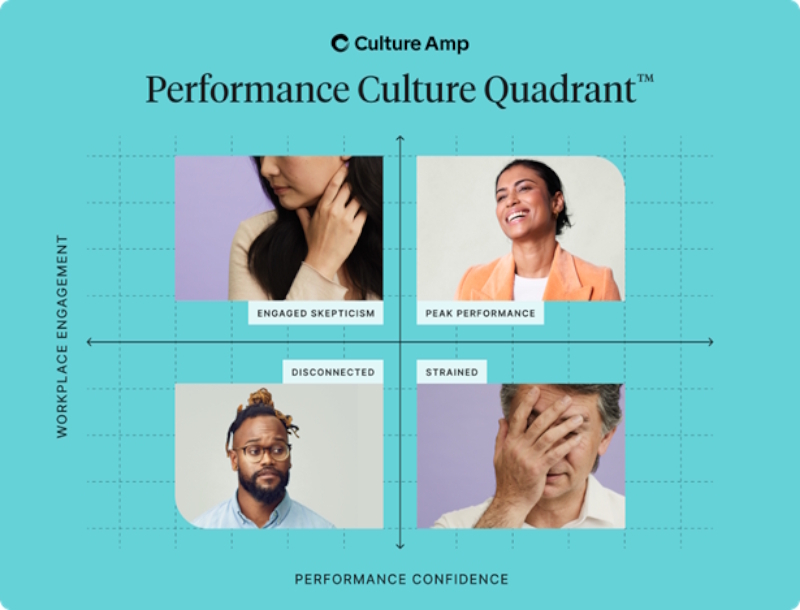
The four company culture types comprise:
- Peak performance (characterised by high employee engagement and high confidence in their organisation’s ability to succeed over time). This is the holy grail: employees are engaged and they believe in where the company is headed.
- Engaged scepticism (high employee engagement but low confidence in their organisation’s ability to succeed over time). Your team may love their work, but they’re unsure of where you’re trying to take the company and the strategies you’ve charted to get there.
- Strained (low levels of employee engagement but high confidence in their organisation’s ability to succeed over time). Employees believe the company is ultimately going to win, but they’re collectively feeling a little tired and perhaps inching closer to burnout.
- Disconnected (low employee work engagement, and low confidence in their organisation’s ability to succeed). This is undoubtedly a tough place to be.
These four classifications of culture help us to understand the current dynamics at play, and act as a strong predictor of the organisation’s performance potential.
After running a distribution, we found that 44% of the companies analysed were in a state of ‘Peak Performance’ culture. And after one year, 76% of them stayed in Peak Performance, telling us that the culture state was both attainable and durable.
By tracking the share price of the listed companies within the 1800 organisations, we found that those attaining the ‘peak performance’ company culture achieved a 25% share price increase over 12 months and a 36% uplift after 24 months. Considering firms in the other culture states fell by -11% points, Peak Performance companies saw a 47% share price change premium.
With a measurement like this, leaders don’t have to rely on their gut to answer the question, “Do we have a high-performing culture?” The guesswork can stop here. This framework and its associated categories provide a means to define the current culture, identify issues and work on key drivers to ultimately move the needle on culture and performance.
Towards Peak Performance
The typological approach assists company leaders in using proprietary analytical and coaching tools to identify and map pathways and specific actions to help their organisation achieve a Peak Performance culture. After diagnosing their culture and quickly answering the ‘dashboard’ question: “Do we have a high-performing culture?” leaders can contextualise their results against people-related key performance indicators such as employee retention, workforce productivity, and workplace efficiency.
Then, perhaps most importantly, leaders can unlock an organisation-wide roadmap towards achieving peak performance - focusing on high-impact growth areas that are specific to their organisation’s culture type. While every company’s culture is unique, there are shared paths we observed companies take on their path to Peak Performance.
Depending on where companies started, their path to Peak Performance looked slightly different.
- Cultures that started off as Sceptical needed collaboration and accountability to reach Peak Performance. Across those areas, companies saw favourability increase by 6-8% points within one year.
- Companies that started in a Disconnected culture state needed leaders to more convincingly communicate a motivating vision and steer more innovation in order to reach Peak. However, it took a little more uplift in favorability - between 10 and 11% points in a year.
- Those starting in the Strained culture state earned an 8-10% point lift in people-centric leadership and commitment to social good on their way to Peak Performance.
On top of improving in their unique respective areas, all companies that got to Peak also had to improve in effectively redirecting resources toward company goals and making cultural change clearly visible. And it took an 8 to 12% point boost in both to get there, regardless of where a company started, though, it was the momentum of intentional culture change that carried organisations to the top.
Connecting decision making and engagement
HR leaders have been advocating for culture investment for years, often without the financial data to justify it in board conversations. This research and science-based typological model changes that dynamic. The data show how investing in workforce engagement to drive performance is a key strategic lever for the business … not the binary ‘performance or culture’ choice of old.
Dr Heather Walker is Lead Data Journalist at Culture Amp
Main image courtesy of iStockPhoto.com and Prostock-Studio

Business Reporter Team
You may also like






Most Viewed


Winston House, 3rd Floor, Units 306-309, 2-4 Dollis Park, London, N3 1HF
23-29 Hendon Lane, London, N3 1RT

020 8349 4363

© 2025, Lyonsdown Limited. Business Reporter® is a registered trademark of Lyonsdown Ltd. VAT registration number: 830519543