



The future of healthcare is closer than we think
Sponsored by DeepHealthHow advances in AI, imaging and automation are enabling earlier disease detection, easing workforce pressures and expanding access to care globally


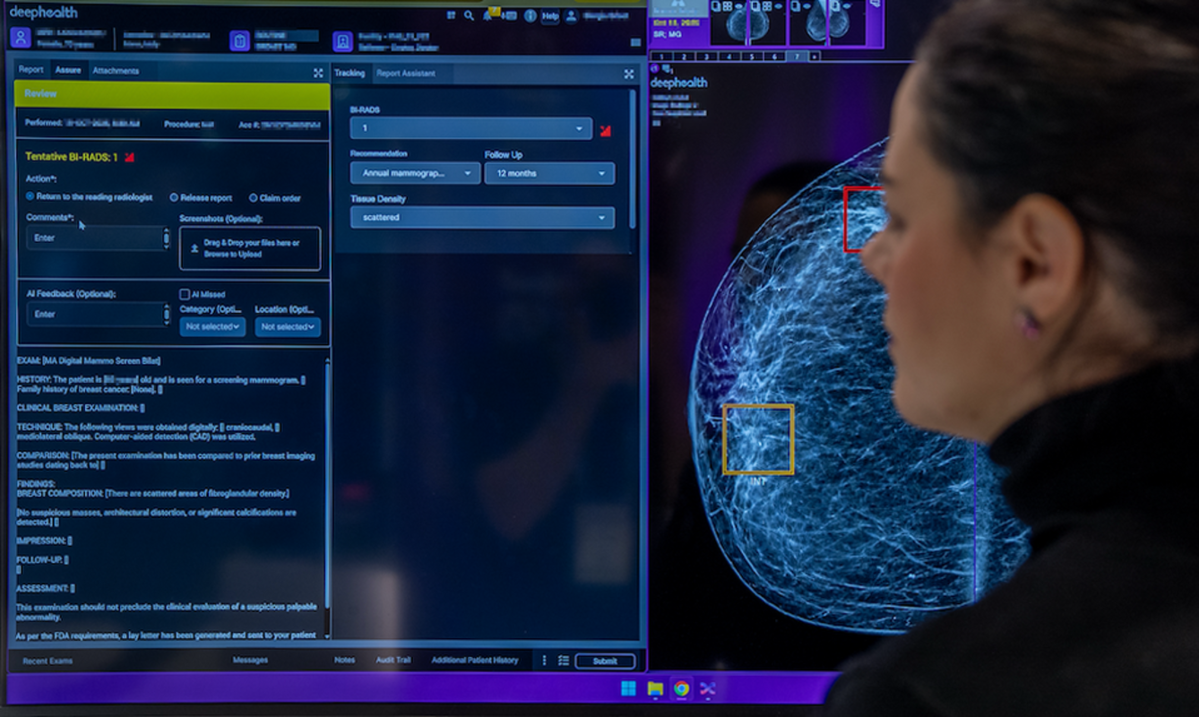
A decade ago, we talked about AI in healthcare the way we talked about self-driving cars: inevitable someday, but not immediately practical. Today, what’s changed isn’t just the algorithms. It’s the economics.
One reason we can now deploy AI at scale is that compute power has vastly increased and the cost of computing is vastly cheaper than it was even five years ago. Hardware efficiency has leapt forward, accelerated by innovations and technology advancements across the ecosystem.
This matters because healthcare doesn’t adopt technology because it’s cool. Healthcare adopts technology when it’s clinically trustworthy, operationally scalable and economically viable, and where there is a deep need for innovation. A deep need to deliver better outcomes, reduce the workforce burden and reduce the cost of care.
That is the moment we’re in.
Right now, we have a once-in-a-generation window to truly transform how and when disease is found, treated and prevented.
Major progress is already in motion
When I think about what I want medical care to look like for my kids as they grow up, three advances immediately come to mind.
The first is stage-shifting disease. That is, catching diseases earlier, when the conditions are more treatable and outcomes tend to be significantly better. I can’t overstate how much cost and suffering in healthcare is driven by the word “late”. Late diagnosis. Late intervention. Late options.
Second, using automation to lighten the load on clinicians and care teams. If we can eliminate and streamline high-volume routine work, we give valuable time back. Not only does this improve workflow and efficiency, it helps ease the burden of staff shortages on health systems. And with fewer onerous tasks to manage, radiologists can devote more time and energy to complex cases where their expertise matters most.
Third is increasing access to care. Diagnostic tests that once required expensive hospital visits are moving outwards: from inpatient to outpatient to retail clinics. And increasingly, to the home. This shift isn’t only about convenience. It’s also about capacity and cost. Every test we can safely and reliably do outside the hospital reduces strain on the system and makes care more broadly available.
Imaging is at the centre of improving care
Foundational to these three major population-level health advances – stage-shifting disease, automating routine tasks and increasing access to care – is the growing role of imaging. No question, technology innovation serves as a critical enabler for this evolution.
But the true catalyst for advancing care lies in how technology is brought together, deployed and scaled.
More than any single breakthrough, I’m most energised by what becomes possible when we look at the entire care ecosystem and pair the right technologies with an ambitious innovation strategy. That means investing across the full imaging continuum, from routine outpatient exams and acute care diagnostics to population‑scale screening programs, so AI can operate where it creates the most value.
When AI is embedded across the full care pathway, the patient journey becomes simpler, faster and far more effective. AI can lift generalist clinicians to near-specialist performance by automatically highlighting subtle abnormalities, prioritising the most urgent cases and reducing the cognitive load that slows care today.
This changes what’s possible at every step.
For example, clinicians can identify neurodegenerative conditions earlier because AI surfaces early imaging signatures that are difficult for the human eye to detect. Screening programs become scalable because AI can safely process far higher exam volumes, enabling earlier cancer detection for more people.
The result is a system where patients move through care with fewer delays, clinicians operate at the top of their licence and health systems can deliver specialist-level care at population scale.
When technology meets real-world practice
As the largest provider of radiology clinical AI solutions and services worldwide, DeepHealth has the technology needed to meet today’s imaging demands. Beyond our technology, what really makes us stand out in the industry is our close relationship with RadNet, one of the largest providers of outpatient imaging services in the US.
This unprecedented connection to clinical practice means we learn from care as it happens: as administrators trying to manage rising volumes with limited staffing, radiologists working late to clear backlogs and technologists having to balance between quality and throughput.
When you sit as close to care delivery as we do, you quickly realise that adding another AI point solution into the mix doesn’t help. If it creates another login, another alert, another exception, then it adds cognitive load to teams that are already stretched.
Why advancing care is personal for me
I come from a family of physicians. I’ve always respected the demands and complexities of care delivery. My passion to truly improve the system, however, became painfully concrete through my own family’s experience.
My father diagnosed his own pancreatic cancer. As a physician himself, he asked to see his CT and found what was still a small tumour. That early timing gave him a narrow window for surgery and more time with us. Later, my mother died of bowel cancer after a fast and brutal progression. Even within a sophisticated healthcare system, her journey was slowed by paper-based, manual processes.
I couldn’t help imagining during these moments how the experiences might have been different if the overall system had been less fragmented.
And then there are the stories that haunt you: a friend diagnosed late, then told there was no path to recovery. With no funded options available to her, she searched beyond the system and ultimately paid out of pocket for her treatment (something many people simply can’t afford). That choice gave her a fighting chance, but it also underscores a difficult truth: access to hope should not depend on personal finances.
That is why, if you ask me what my biggest concern for the future is, it’s not directly about technology. The biggest challenge ahead is access. Today, there’s still a gap between the care technology makes possible and the care patients can access. If we’re not careful, this gap will widen faster than innovation can close it.
A new business model for solving care challenges
Imaging demand is projected to outpace radiologist supply by double digits in some regions. In this context, solving delivery challenges requires much more than innovation. It requires coherence. By this, I mean a unified framework within which integration and scale are inherent.
Unifying, simplifying and streamlining are fundamentals. It’s why we focus on end-to-end workflows, not standalone tools. It’s why we validate that solutions reduce burden and improve outcomes in real-world clinical practice.
And it’s why we are growing in a meaningful way. We now have a comprehensive regulatory-approved portfolio validated at scale that supports more than 75 indications – a measure of our broad capabilities that gives patients a fuller picture of their health.
Beyond deepening our ability to support high-volume routine imaging and acute care, this massively accelerates what we can make possible in healthcare. Ambitions we thought would take a decade to accomplish might now happen in the next few years.
What I’m talking about isn’t simply technological innovation. It’s making modern imaging care available and sustainable across geographies and health systems, and for millions of patients.
This is how we are shaping the future. Advancing care that adapts around people, not the other way around.
To learn more about DeepHealth and its ambitious aim to advance health at population-level with AI-powered screening and diagnostic care, click here.
By Kees Wesdorp, President and CEO, DeepHealth

Business Reporter Team
You may also like

Most Viewed


Winston House, 3rd Floor, Units 306-309, 2-4 Dollis Park, London, N3 1HF
23-29 Hendon Lane, London, N3 1RT

020 8349 4363

© 2025, Lyonsdown Limited. Business Reporter® is a registered trademark of Lyonsdown Ltd. VAT registration number: 830519543